Guides
Reduced Lottery Systems with a Guarantee: How Many Tickets Do You Need?
In short
A reduced lottery system with a guarantee uses fewer tickets than a full system, but its promise only applies when all the drawn numbers are among yours. We show the smallest number of tickets needed — for example 4 instead of 28 with eight numbers — how we know fewer is impossible, and why no arrangement improves the odds of a single ticket.
If you pick 8 numbers in Lotto and want to play every six-number line they contain, you buy a full system: 28 tickets. With 9 numbers it is 84 tickets, with 10 it is 210. A reduced system keeps only some of these lines, chosen so that in a given situation one of the tickets is sure to win a prize of a given tier. How many tickets are enough is a question of combinatorics — and it has exact answers.
How to read the guarantee
In this article we count guarantees such as “five if six of your eight numbers are drawn”. It means: if all 6 drawn numbers are among your 8, at least one ticket in the system has at least 5 matches. If fewer than six of your numbers are drawn, the guarantee promises nothing. The general rules for reading such guarantees are on the shortened (reduced) systems page.
The condition is rare. The chance that all 6 drawn numbers are among 8 chosen ones is C(8, 6) ÷ C(49, 6) = 28 ÷ 13,983,816, or 1 in 499,422. With 9 numbers it is 1 in 166,474.
The page content remains available.
The smallest number of tickets
The table gives the smallest number of tickets that guarantees three, four or five matches when six of your n numbers are drawn. We checked every exact value by computer — the solver proved that no smaller system exists.
| Numbers | Full system | Three | Four | Five |
|---|---|---|---|---|
| 7 | 7 | 1 | 1 | 1 |
| 8 | 28 | 1 | 1 | 4 |
| 9 | 84 | 1 | 3 | 7 |
| 10 | 210 | 2 | 3 | 11–14 |
| 11 | 462 | 2 | 5 | — |
| 12 | 924 | 2 | 6 | — |
Smallest number of Lotto tickets that guarantees three, four or five matches when six of your n numbers are drawn. “11–14” — the exact value is not known to us; “—” — not calculated.
The first rows may be surprising: with 7 or 8 numbers any single ticket gives five or four matches. This is not a trick, just arithmetic. If all 6 drawn numbers are among your 8, only 2 of them were not drawn — and a ticket leaves out 2 of your numbers, so it loses at most 2 matches.
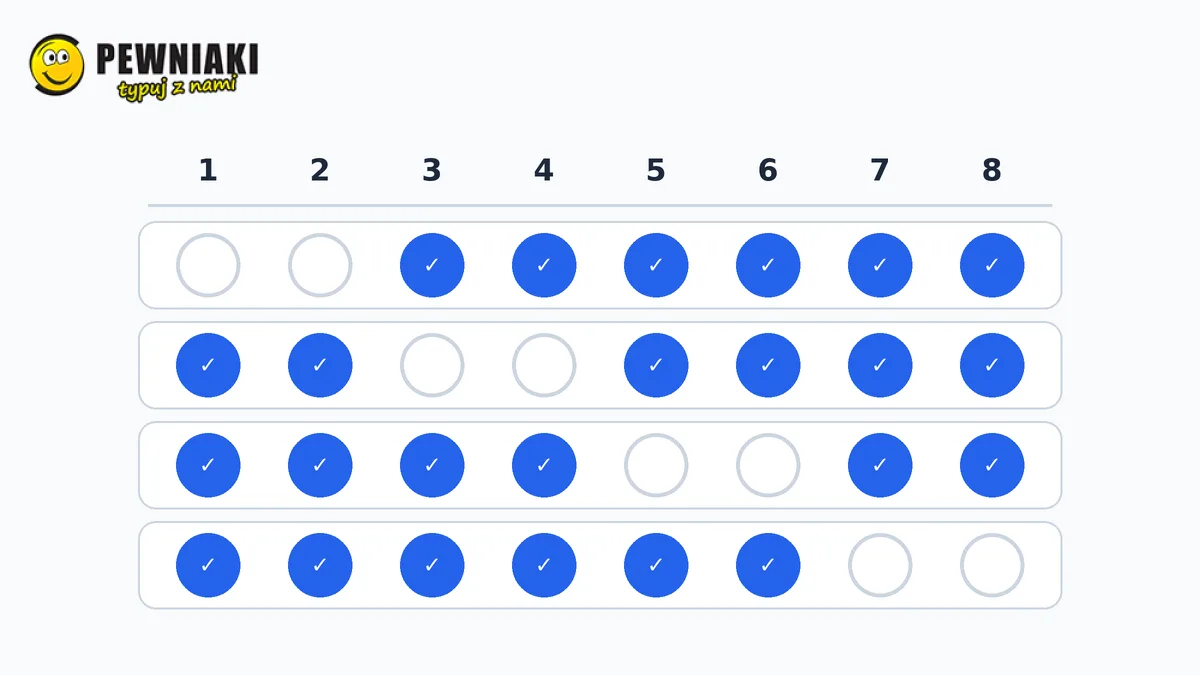
Example: 8 numbers and 4 tickets that guarantee five
Sort your numbers from smallest to largest and call them positions 1–8. Each of the four tickets leaves out one pair of positions:
- positions 3, 4, 5, 6, 7, 8 (leaves out 1 and 2);
- positions 1, 2, 5, 6, 7, 8 (leaves out 3 and 4);
- positions 1, 2, 3, 4, 7, 8 (leaves out 5 and 6);
- positions 1, 2, 3, 4, 5, 6 (leaves out 7 and 8).
Why does it work? When all 6 drawn numbers are among your 8, exactly 2 of them were not drawn. Take the ticket that leaves out the pair containing one of them. That ticket has at most one number that was not drawn, so it has at least 5 matches.
Why are 3 tickets not enough? Three tickets leave out at most 6 positions between them. If the two numbers that are not drawn happen to sit in the remaining positions, every ticket contains both and has only 4 matches. In general the left-out numbers must cover at least 7 of your numbers — hence 4 tickets for 8 numbers (a guarantee of five) and 3 tickets for 9 numbers (a guarantee of four, leaving out 1–3, 4–6 and 7–9).
9 numbers and a guarantee of five: 7 tickets instead of 84
With 9 numbers, five matches take more work. This system has 7 tickets (positions from the smallest number):
- 4, 5, 6, 7, 8, 9;
- 3, 5, 6, 7, 8, 9;
- 2, 5, 6, 7, 8, 9;
- 1, 2, 3, 4, 8, 9;
- 1, 2, 3, 4, 6, 7;
- 1, 2, 3, 4, 5, 9;
- 1, 2, 3, 4, 5, 8.
That 6 tickets are not enough follows from Mantel’s theorem in graph theory (which gives at least 6) together with an exhaustive computer search (which rules out 6). For 10 numbers we do not know the exact answer: it takes between 11 and 14 tickets. This is the same kind of problem as combinatorial coverings, where many values are still unknown.
Does a reduced system improve your chances?
No. Every ticket — whichever numbers you mark — has the same distribution of matches: on average 36/49, about 0.73 matches. The expected value of several tickets is the sum of the expected values of the single tickets, so the 4 tickets of a reduced system give on average exactly as much as any other 4 tickets. The arrangement only changes how prizes are spread across draws: in a rare situation something is certain, in all other draws there is no promise at all.
The guarantee is also about the prize tier, not the amount. Prizes for four and five matches in Lotto depend on how many winners there are in a given draw.
Calculate it yourself
- Shortened systems — ready-made systems with a guarantee for 7, 8 and 9 numbers, filled in with your numbers.
- Lottery System Calculator — how many tickets a full system has and what it costs.
- Lottery Odds Calculator — the odds of any number of matches on one ticket.
Read more
- Shortened and Full Systems — What's the Difference
- How Are Lottery Odds Calculated?
- Probability Academy
Lottery games are for adults only (18+). A reduced system does not change the odds of any ticket — it only changes the number of tickets and the situation in which something is certain.
Tags: reduced systems full system combinatorics lotto guarantee